
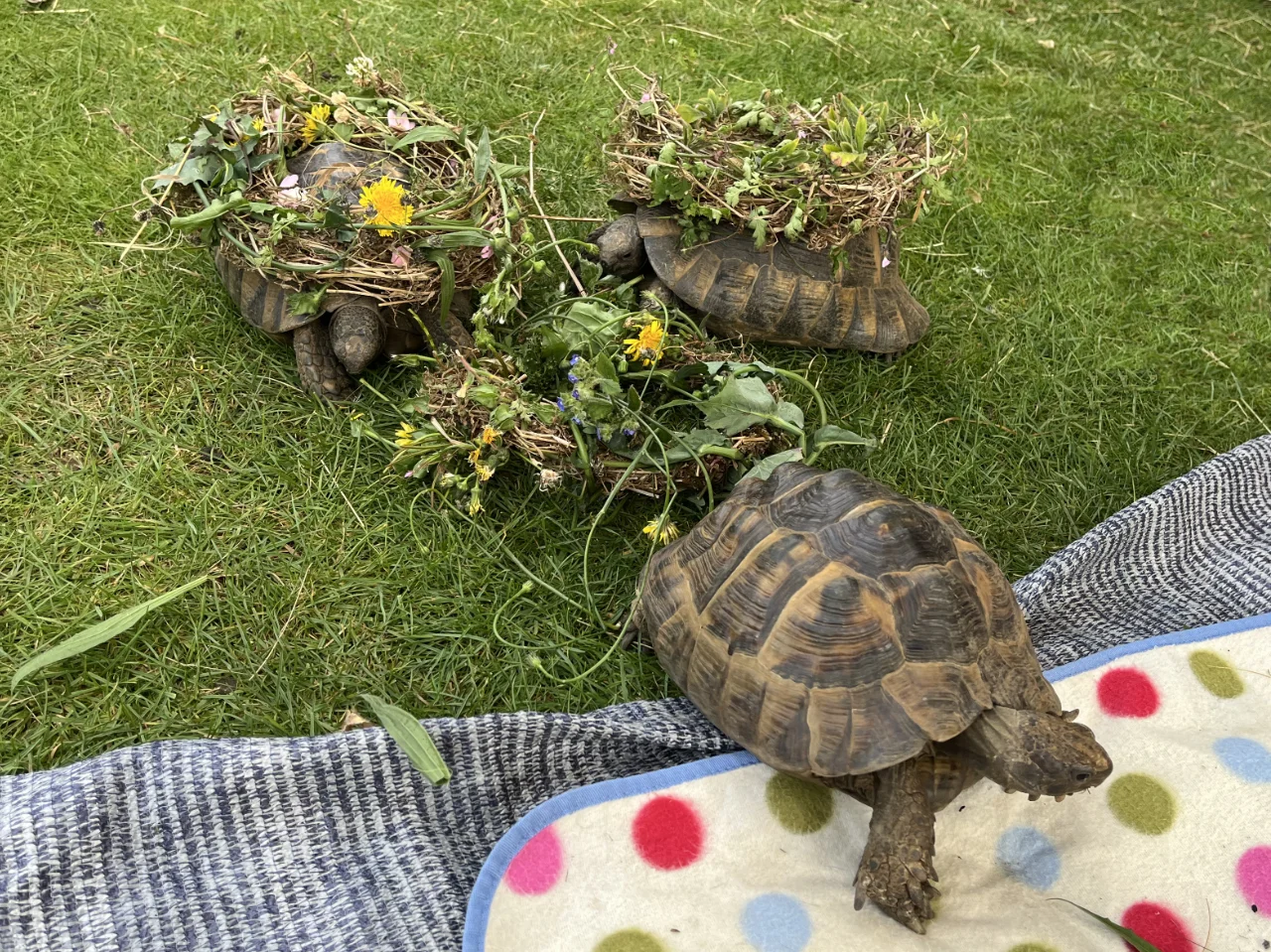
Porsche, Clover & Vicky – Spur Thigh Tortoises
| Scientific Name | Testudo Graeca Ibera (TGI) |
| Colourings | Brown with lighter brown and golden edges to their shell |
| Date of Birth (Approx.) | Porsche and Clover 2003 Vicky 2005 |
| Gender | Female |
| Country of Origin | Turkey, albeit they can be found widely spread across Bulgaria, Greece, Turkey, Iran, Syria, Iraq and Jordan. View on Google Earth |
| Habitat | Semi-Arid (dry) Areas, Scrub Forest and Grasslands |
| Average Life Span | 30 – 55 Years (occasionally up-to 80 years in captivity) |
| Alternative Name | Greek Tortoise or Mediterranean Spur-thighed Tortoise |
| Interesting Facts | The Spur Thigh tortoise has a spur (bony projection) on the underside of their hind leg, hence their name. They are a hibernating species, and we see them find a hibernating spot from the end of October through to around the middle of March. |

Note that whilst there is no specific listing for the TGI (as there is still some confusion over the genetics of the tortoise) However, the common Greek Spur Thigh (Testudo graeca) is listed as vulnerable.
Information & Care
Understanding Porsche, Clover & Vicky
Our Spur Thigh Tortoises are bold, confident and would follow you down the garden for a treat!
Porsche and Clover have lived with us since they were two years old, and Vicky was handed over to us in 2022 for her own safety as the new family dog was chewing her shell, which would have been very painful.
Spur Thigh Tortoises are diurnal (daytime active) and are most active, after they have warmed up in either the sun, or their heat lamps. Like most tortoises, they may bask in full sun, but on very hot days, they may also hide away.
Porsche and Clover are healthy looking tortoises, but Vicky arrived with a badly damaged shell, and rough looking dry skin, so is easy to distinguish from her friends.
Our Spur Thigh Tortoises are bold, confident and would follow you down the garden for a treat!
Porsche and Clover have lived with us since they were two years old, and Vicky was handed over to us in 2022 for her own safety as the new family dog was chewing her shell, which would have been very painful.
Spur Thigh Tortoises are diurnal (daytime active) and are most active, after they have warmed up in either the sun, or their heat lamps. Like most tortoises, they may bask in full sun, but on very hot days, they may also hide away.
Porsche and Clover are healthy looking tortoises, but Vicky arrived with a badly damaged shell, and rough looking dry skin, so is easy to distinguish from her friends.
Most tortoises are solitary and can be territorial. If kept as a group, they need a large space, with plenty of areas for each tortoise to hide and enough food for guarding not to take place. All three tortoises roam the walled garden, and we have to monitor their behaviour in summer, in particular as even three females together can show aggression towards each other.
Spur Thigh Tortoises are vegetarians that would eat a high fibre, predominantly weed based diet in the wild. As such, we feed them:
– Weeds, such as dandelion, milk thistle, plantain (pointed and broad leaf)
– Dark leafy greens (avoiding spinach, broccoli etc.)
– Salad Leaves (not iceberg lettuce)
In summer, the tortoises can be left to free roam and forage for themselves (if sufficient variety of weeds are present), but this may need to be supplemented.
Our herd of tortoises live outside in the garden (in summer). They have a 6ft x 3 ft greenhouse for shelter and warmth on cooler days and at the start and end of the season, they have access to basking lamps, heat bulbs and UV light. In summer, these are all switched off to encourage the tortoises to access the outside and natural UV/Sunlight. Their equipment includes:
– Basking Heat Bulb Deep Heat Projector) – Temperature ranges 90-95 f (32-35) in the basking spot.
– 2 x D3 UVB Basking / Heat Bulbs
Substrate
The greenhouse has a deep mix of Organic topsoil with Coarse Orchid Bark and Play Sand – in places deep enough for creating scrapes or shallow burrows.
The tortoise herd loves to romp around the garden, moving in and out of the bushes, scrambling over low level logs / rocks and visiting us on the patio. The tortoises may exhibit male breeding behaviours, and ‘ram’ the other tortoises, so this has to be monitored to prevent shell damage. All tortoises are also of egg laying age and should be seen to lay (unfertilised) eggs in the greenhouse, or garden. We provide a loose sand/soil area for this, as otherwise the tortoises can become egg-bound (medical emergency).
In the summer (their breeding season), their water bowl is placed in the greenhouse and needs to be changed daily.
– Monitoring their activity levels, to check they are basking in the mornings and foraging, eating and moving around either their greenhouse or on warmer days, the garden.
– Switch lamps on in the mornings and switch off again in the evenings (manual switches)
– Check lights have all come
– Water change (use reptisafe, dechlorinator)
– Feed (twice a day, when needed)
Daily – Spot clean (when faeces are seen)
– Water bowl cleaned daily, or as contaminated (the tortoises will urinate and defecate in their water bowl)
Weekly – Full clean, this includes
– checking all through the enclosure and removing any faeces, plus re-mixing / agitating and aerating the substrate
– The water bowl should be thoroughly washed and disinfected using F10, vivarium clean weekly.
Quarterly – Deep clean, this includes
– Removing all of the old substrate and disposing and replacing with fresh
– Fully clean the greenhouse, wood and glass
– Water bowl cleaned daily, or as contaminated (the tortoises will urinate and defecate in their water bowl)
Weekly – Full clean, this includes
– checking all through the enclosure and removing any faeces, plus re-mixing / agitating and aerating the substrate
– The water bowl should be thoroughly washed and disinfected using F10, vivarium clean weekly.
Quarterly – Deep clean, this includes
– Removing all of the old substrate and disposing and replacing with fresh
– Fully clean the greenhouse, wood and glass
Did you know?
These tortoises have a unique way of communicating—they don’t vocalize like many animals, but they use head-bobbing and physical movements to interact with each other. If that doesn’t work, they might resort to ramming each other with their shells in a slow-motion showdown! It’s a subtle but effective form of tortoise “conversation,”
Health Check & Emergencies
Like all our animals, the tortoise herd should be regularly checked to make sure they are of good condition and health. The following form should be completed at least once a month. You will be prompted to complete an animal medical record should any answer cause concern.
This is a table showing the Yes/No answers of previous submissions. If the full data submission is required, this must be done from the website backend.
Spur Thigh’s Health Check
On health checking, if there are any areas of cause for concern, then make an appointment at Chine House Vets.
– The tortoise(s) behaviour changes suddenly, e.g. If the tortoises are constantly hiding away, are not eating, look lethargic, they will need close monitoring and should this continue over 48 hours, a vet will be required.
– There is discharge from the nose or mouth
– The faeces are runny or have blood in them
– The tortoise is struggling or straining to lay eggs (mid summer)
– The tortoise(s) behaviour changes suddenly, e.g. If the tortoises are constantly hiding away, are not eating, look lethargic, they will need close monitoring and should this continue over 48 hours, a vet will be required.
– There is discharge from the nose or mouth
– The faeces are runny or have blood in them
– The tortoise is struggling or straining to lay eggs (mid summer)
Supplies & Reference
Here are the regular supplies list for our reptiles. Links are provided to 3rd party websites and are subject to change.
| Item | Where to buy |
|---|---|
| Heating & Lighting | |
| Arcadia D3 UV Basking Lamp 100W | Amazon |