
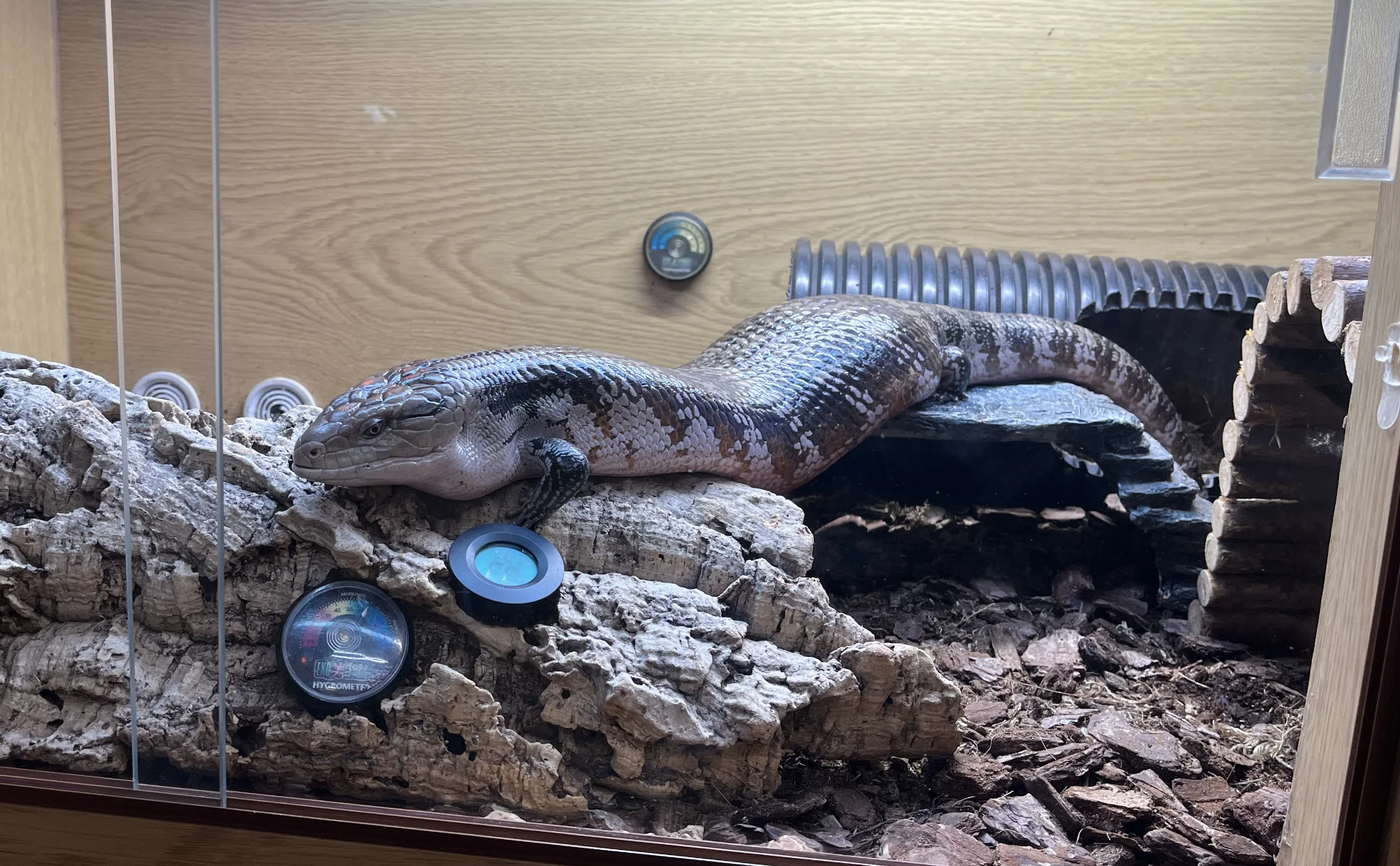
Slushy our Blue Tongued Skink
| Scientific Name | Tiliqua Spp. |
| Colourings | Black / Silver banded with red under-belly, and blue tongue. |
| Date of Birth (Approx.) | January 2019 |
| Gender | Uncertain |
| Country of Origin | Indonesia View on Google Earth |
| Habitat | In the wild, the Irian Jaya Blue Tongue Skinks live in tropical, humid climates. |
| Average Life Span | Approximately 15-20 years |
| Alternative Name | N/A |
| Interesting Facts | Irian Jaya blue tongue skinks are the most diverse group of blue tongue skinks, as they are taxonomically incomplete. meaning they are yet to be scientifically classified. |
Information & Care
Understanding Slushy
Slushy came to live with us in November 2019, as a ‘male’, but as Slushy as grown and developed, we believe Slushy may actually be a female. Like most Blue Tongued Skinks, Slushy can be a bit wary of new circumstances and people, and prefers not to be overly handled, but is very gentle.
Blue Tongued Skinks are reportedly poor swimmers and climbers. They are classified as terrestrial, with a fossorial nature (fossorial means they like to burrow and bury themselves in the leaf litter / substrate). That said, Slushy loves to climb in her water bowl and loves to climb onto her hides and platforms in the daytime and loves to hide away and bury herself at night,
Blue Tongued Skinks are diurnal lizards (active during the day) and like to bask in the sun, which we try to replicate (see later UV requirements).
Blue Tongue Skinks can huff (sounds like a hiss) and it is thought this is a form of defence (mimicking a snake). If slushy is doing this, it is a sign that s/he is unhappy with the handling or stressed and handling needs to be adjusted. If this is accompanied with displaying the tongue, then this would further suggest s/he feels threatened.
Normal behaviour for Slushy, would be to be seen basking in the early morning under the basking light and / or climbing onto the platforms and hides. Slushy can then be seen to hide away at night, usually in the humid hide (black tube).
It is relatively normal for Slushy to poop just once/twice a week, depending on the amount of food previously eaten.
Slushy came to live with us in November 2019, as a ‘male’, but as Slushy as grown and developed, we believe Slushy may actually be a female. Like most Blue Tongued Skinks, Slushy can be a bit wary of new circumstances and people, and prefers not to be overly handled, but is very gentle.
Blue Tongued Skinks are reportedly poor swimmers and climbers. They are classified as terrestrial, with a fossorial nature (fossorial means they like to burrow and bury themselves in the leaf litter / substrate). That said, Slushy loves to climb in her water bowl and loves to climb onto her hides and platforms in the daytime and loves to hide away and bury herself at night,
Blue Tongued Skinks are diurnal lizards (active during the day) and like to bask in the sun, which we try to replicate (see later UV requirements).
Blue Tongue Skinks can huff (sounds like a hiss) and it is thought this is a form of defence (mimicking a snake). If slushy is doing this, it is a sign that s/he is unhappy with the handling or stressed and handling needs to be adjusted. If this is accompanied with displaying the tongue, then this would further suggest s/he feels threatened.
Normal behaviour for Slushy, would be to be seen basking in the early morning under the basking light and / or climbing onto the platforms and hides. Slushy can then be seen to hide away at night, usually in the humid hide (black tube).
It is relatively normal for Slushy to poop just once/twice a week, depending on the amount of food previously eaten.
Irian Jaya blue tongued skinks do not normally brumate and slushy, so far has never shown an inclination to brumate, although eating slows a little in winter.
Blue Tongue Skinks are solitary species; therefore Slushy is housed individually.
Slushy should be fed 1-2 times weekly, but as s/he is a little overweight, once a week, and / or strict portion control is important.
50-60% of their diet should be high-protein foods, such as dog or cat food (no fish flavors), chicken hearts, chicken gizzards, eggs, mice, dubia roaches, grasshoppers, locusts, snails and earthworms
Leafy greens and other vegetables should make up 40-50% of Slushy’s diet, although Slushy is a picky eater. Safe vegetables: collard greens, cactus pads, spring mix, arugula, kale, pea shoots, alfalfa, bok choy, carrot greens, spinach, dandelion greens/flowers, hibiscus leaves/flowers .
Slushy has a walk in water bowl, which should be refreshed daily with one drop of reptisafe added.
50-60% of their diet should be high-protein foods, such as dog or cat food (no fish flavors), chicken hearts, chicken gizzards, eggs, mice, dubia roaches, grasshoppers, locusts, snails and earthworms
Leafy greens and other vegetables should make up 40-50% of Slushy’s diet, although Slushy is a picky eater. Safe vegetables: collard greens, cactus pads, spring mix, arugula, kale, pea shoots, alfalfa, bok choy, carrot greens, spinach, dandelion greens/flowers, hibiscus leaves/flowers .
Slushy has a walk in water bowl, which should be refreshed daily with one drop of reptisafe added.
Vivarium
Slushy lives in a 150 x 60 x 60cm wooden vivarium with glass sliding doors.
Heat & Lighting
– Luminez Linked UVB Lighting (14% UVB) for Fergusson Zone 3 (a partial / open sun basker) with a solar meter reading of 3-4 on a 12 hour day / night cycle in winter and a 14 hour light cycle in summer. The UV % of a new bulb may need to be reduced via the App downwards to keep the UVI below 4.
– Slushy has a linked Luminez LED Jungle Dawn Bar. Both the LED and UVB lighting are controlled via a bluetooth App, and are programmed to come on at 08:00am and switch off at 20:00.
Vivarium Lighting and heating
– Luminez UVB T5 (14%) for Fergusson Zone 3 with a solar meter reading of 3-4 on a 12 hour day / night cycle
– Luminez LED Bar on a 12 hours day / night cycle
– The cooler end of the vivarium should ideally be 80-85F (27-29c)
– Night time – the vivarium can drop to 68-72 f (20-22c) at night.
Heating
Slushy, like all reptiles, needs a temperature gradient in the vivarium for health. Slushy has a basking heat bulb (Deep heat projector) controlled via a Habistat Pulse Proportional Thermostat. S/he has thermometers and hygrometers on both sides of the enclosure to check ambient temperatures and we use a laser thermometer to test basking and surface temperatures. Temperatures as follows:
– Basking spot surface temperature — 100-105°F (38-41°C)
– Cool side surface temperature — 75-85°F (24-29°C)
– Nighttime — 70-75°F (21-24°C)
The Irian Jaya Blue Tongue Skink needs a high level of humidity.
Ideal daytime humidity will be between 60%- 80%, maintained through morning and evening misting and mixing of the substrate.
Substrate
Slushy needs a substrate similar to a wild environment, so we make up our own mix of 40% organic, additive-free topsoil + 20% Zoo Med Reptisoil + 20% play sand + 20% Zoo Med Fine Orchid Bark. In places, this should be around 3 inches deep to allow burrowing.
Slushy also needs a humid hide made up of sphagnum moss.
Slushy lives in a 150 x 60 x 60cm wooden vivarium with glass sliding doors.
Heat & Lighting
– Luminez Linked UVB Lighting (14% UVB) for Fergusson Zone 3 (a partial / open sun basker) with a solar meter reading of 3-4 on a 12 hour day / night cycle in winter and a 14 hour light cycle in summer. The UV % of a new bulb may need to be reduced via the App downwards to keep the UVI below 4.
– Slushy has a linked Luminez LED Jungle Dawn Bar. Both the LED and UVB lighting are controlled via a bluetooth App, and are programmed to come on at 08:00am and switch off at 20:00.
Vivarium Lighting and heating
– Luminez UVB T5 (14%) for Fergusson Zone 3 with a solar meter reading of 3-4 on a 12 hour day / night cycle
– Luminez LED Bar on a 12 hours day / night cycle
– The cooler end of the vivarium should ideally be 80-85F (27-29c)
– Night time – the vivarium can drop to 68-72 f (20-22c) at night.
Heating
Slushy, like all reptiles, needs a temperature gradient in the vivarium for health. Slushy has a basking heat bulb (Deep heat projector) controlled via a Habistat Pulse Proportional Thermostat. S/he has thermometers and hygrometers on both sides of the enclosure to check ambient temperatures and we use a laser thermometer to test basking and surface temperatures. Temperatures as follows:
– Basking spot surface temperature — 100-105°F (38-41°C)
– Cool side surface temperature — 75-85°F (24-29°C)
– Nighttime — 70-75°F (21-24°C)
The Irian Jaya Blue Tongue Skink needs a high level of humidity.
Ideal daytime humidity will be between 60%- 80%, maintained through morning and evening misting and mixing of the substrate.
Substrate
Slushy needs a substrate similar to a wild environment, so we make up our own mix of 40% organic, additive-free topsoil + 20% Zoo Med Reptisoil + 20% play sand + 20% Zoo Med Fine Orchid Bark. In places, this should be around 3 inches deep to allow burrowing.
Slushy also needs a humid hide made up of sphagnum moss.
Slushy has several platforms and hides to both hide under and to bask on. A favourite is the slate under the basking area, and the underground tunnel filled with moss. At night time, Slushy can mainly be found buried into the substrate or in the plastic tunnel.
(When not Brumating)
– Check doors are closed / secure
– Check UV lights is on (UVI reading is ideal at 3-4)
– Check basking spot temperature is 100-105°F (38-41°C)
– Check Cool side surface temperature is 75-85°F (24-29°C)
– Check humidity is 60-80% and spray morning and evening
– Water change (use reptisafe)
– Check doors are closed / secure
– Check UV lights is on (UVI reading is ideal at 3-4)
– Check basking spot temperature is 100-105°F (38-41°C)
– Check Cool side surface temperature is 75-85°F (24-29°C)
– Check humidity is 60-80% and spray morning and evening
– Water change (use reptisafe)
Daily
Spot clean, when faeces are seen.
Weekly full clean. This includes checking all through the enclosure and removing any faeces
– The water bowl should be thoroughly washed and disinfected using F10, vivarium clean
– Glass doors should be cleaned inside and our (inside with white wine vinegar)
– The substrate should be agitated to prevent mold and the substrate becoming stagnant. The humidity should be kept high (60-80%), with the sphagnum moss in Slushy’s tunnel remaining damp.
Quarterly – Deep clean. The deep clean includes:
– Removing all of the old substrate and disposing
– Fully clean the bottom, and sides of the vivarium, and disinfect
– Remove all hides and enrichment and where appropriate (not for wood), disinfect using F10. Refill substrate, ensuring adequate depth (around 3 inches).
Spot clean, when faeces are seen.
Weekly full clean. This includes checking all through the enclosure and removing any faeces
– The water bowl should be thoroughly washed and disinfected using F10, vivarium clean
– Glass doors should be cleaned inside and our (inside with white wine vinegar)
– The substrate should be agitated to prevent mold and the substrate becoming stagnant. The humidity should be kept high (60-80%), with the sphagnum moss in Slushy’s tunnel remaining damp.
Quarterly – Deep clean. The deep clean includes:
– Removing all of the old substrate and disposing
– Fully clean the bottom, and sides of the vivarium, and disinfect
– Remove all hides and enrichment and where appropriate (not for wood), disinfect using F10. Refill substrate, ensuring adequate depth (around 3 inches).
Did you know?
Their bright blue tongue isn’t just for show—it’s a defense mechanism. When threatened, they’ll puff up their body, hiss, and flash that vivid tongue to startle predators. It’s like nature’s version of a warning sign, mimicking something toxic or dangerous to scare off attackers.
Health Check & Emergencies
Like all our animals, Slushy should be regularly checked to make sure s/he is in good condition and healthy. The following form should be completed at least once a month. You will be prompted to complete an animal medical record should any answer cause concern.
This is a table showing the Yes/No answers of previous submissions. If the full data submission is required, this must be done from the website backend.
Slushy will need a vet if s/he has any (non-minor) scale damage that poses a risk of infection, or has any lumps (possible impaction), behavioural changes or any burns. Should her mobility deteriorate and impact her daily life, she should also be seen by a vet.
On health checking, if there are any areas of cause for concern, then make an appointment at Chine House Vets.
● Slushy’s behaviour changes suddenly.
● Slushy is eating or drinking less, or is losing weight
● There is discharge from Slushy’s nose or mouth
● Slushy has trouble shedding, or there are bits of old skin remaining after the rest of the skin has shed.
● Slushy is not defecating normally, or the faeces are runny or have red / blood in them.
On health checking, if there are any areas of cause for concern, then make an appointment at Chine House Vets.
● Slushy’s behaviour changes suddenly.
● Slushy is eating or drinking less, or is losing weight
● There is discharge from Slushy’s nose or mouth
● Slushy has trouble shedding, or there are bits of old skin remaining after the rest of the skin has shed.
● Slushy is not defecating normally, or the faeces are runny or have red / blood in them.
Supplies & Reference
Here are the regular supplies list for our reptiles. Links are provided to 3rd party websites and are subject to change.
| Item | Where to buy |
|---|---|
| Heating & Lighting | |
| UVB Luminez T5 UVBulb (14%) (measure for accuracy before ordering) | Monkfield Reptile |
| Basking Heat Bulb | Monkfield Reptile |
| Substrate | |
| Desert Substrate | Monkfield Reptile |
| Type 1 – Coarse Husk | Monkfield Reptile |
| Type 2 – Orchid Bark (25L) | Monkfield Reptile |
| Type 3 – Organic Topsoil (50L) | Wickes |
| Food & Water | |
| Reptisafe water dechlorinator | Monkfield Reptile |
| Dubai Roaches | In House (bred at AiM) |
| Grass Hoppers | Pets at Home |
| Crickets | Pets at Home |
| Meal & Morio Worms | In House (bread at Aim) |
| Item | Reference Link |
|---|---|
| How to use the LumenIZE App | YouTube (Arcadia) |