
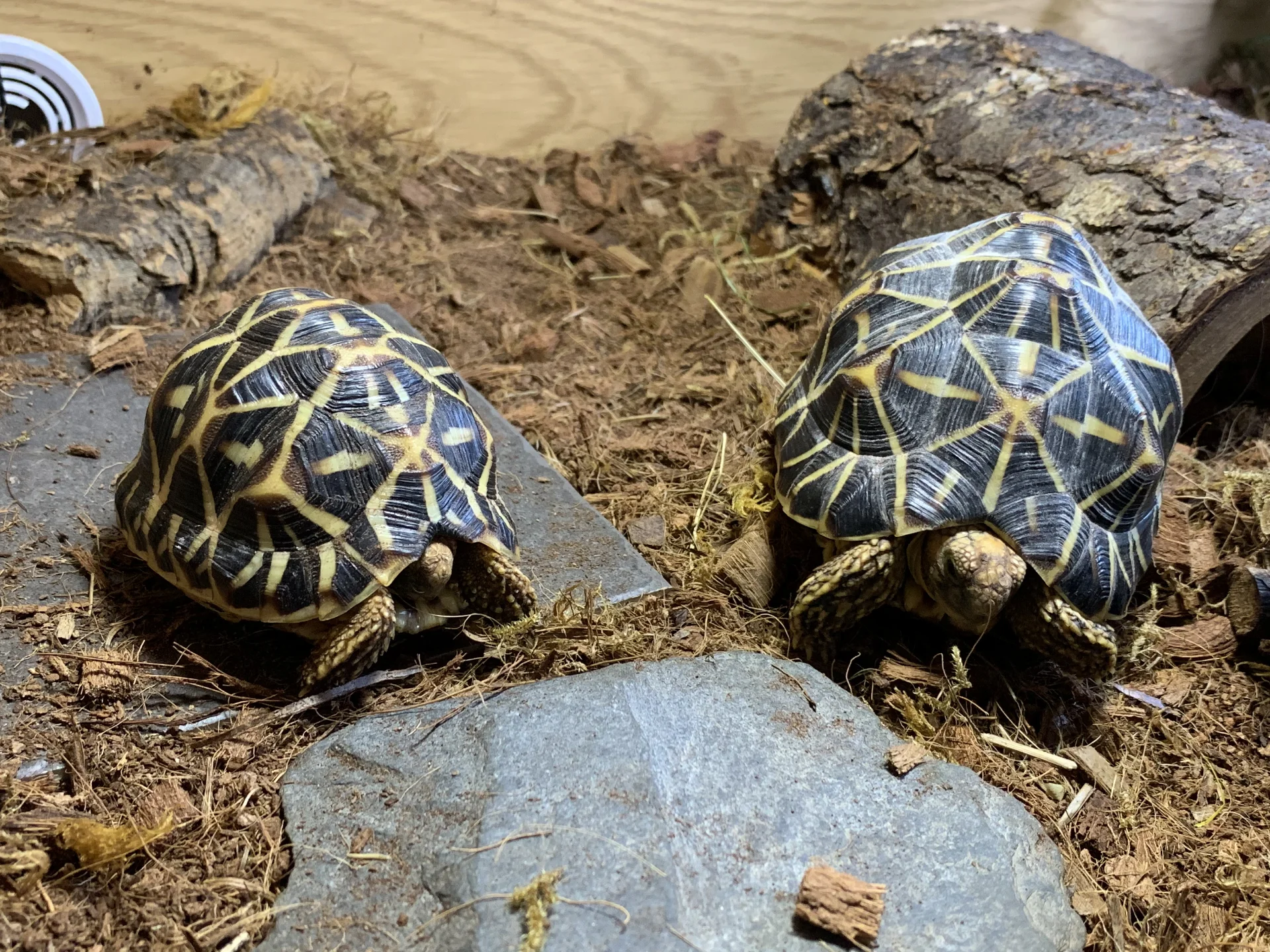
Elvis & Prescilla – Indian Star Tortoises
| Scientific Name | Geochelone Elegans |
| Colourings | Black / Yellow / Gold shells with star patterns with tan and brown body |
| Date of Birth (Approx.) | 5th July 2019 |
| Gender | Elvis – Male, Prescilla – Female |
| Country of Origin | India, Pakistan and Sri Lanka View on Google Earth |
| Habitat | Semi-Arid Areas, Scrub Forest and Grasslands |
| Average Life Span | 30 – 55 Years (occasionally up-to 80 years in captivity) |
| Alternative Name | Star Tortoise: The most common alternative name, emphasizing the star-like pattern on its shell. |
| Interesting Facts | Male tortoises can be significantly smaller than females as can those from Sri Lanka, whereas those from mainland India tend to be on the larger size. Indian Star Tortoises are a non-hibernating species. We believe Elvis (who is tiny) is a Sri-Lankan species and Precilla, who is significantly larger is of Indian ancestry |

Information & Care
Understanding Elvis & Prescilla
Indian Star Tortoises are stunning tortoises. They can be shy, but with time and patience they are fine with handling, but would not like to be handled a lot, which we respect.
Elvis and Prescilla are diurnal (daytime active) and are most active during early morning and mid-afternoon. They like to hide away in the peak of the day (and heat) to sleep.
Indian Star Tortoises are stunning tortoises. They can be shy, but with time and patience they are fine with handling, but would not like to be handled a lot, which we respect.
Elvis and Prescilla are diurnal (daytime active) and are most active during early morning and mid-afternoon. They like to hide away in the peak of the day (and heat) to sleep.
Indian star tortoises do not object to the company of other Indian Stars, and although not classified as social, they will happily live in the company of others.
Indian Star Tortoises are vegetarians that would eat a high fibre, predominantly grass based diet in the wild. As such, we feed them:
– Grasses and timothy hay
– Weeds, such as dandelion, milkthistle, plantain (pointed and broad leaf)
– Dark leafy greens (avoiding spinach, broccoli etc)
– Kale (sparingly)
– Salad Leafs (not iceberg)
– Oral vitamins sprinkled on fresh food 3 x per week
– Calcium powder sprinkled on fresh food 4 x per week
Vivarium
Prescilla and Elvis live in a wooden and glass vivarium measuring 210cmLx60cmDx60cmH (7ft x 2 ft x 2 ft)in winter, but spend time outdoors in summer.
Heat & Lighting
– Luminez UVB T5 (14%) for Fergusson Zone 3 with a solar meter reading of 3-4 on a 12 hour day / night cycle
– Luminez LED Bar on a 12 hours day / night cycle
– Basking Heat Bulb – Temperature ranges 90-95 f (32-35) in the basking spot. Temperature of the basking spot / heat is controlled via a Habistat Pulse Proportional Thermostat.
– The cooler end of the vivarium should ideally be 80-85F (27-29c)
– Night time – the vivarium can drop to 68-72 f (20-22c) at night.
– Hygrometer
– Thermometer
Substrate
Coconut coir / Husk or Organic top soil with Coarse Orchid Bark – in places deep enough for creating scrapes or shallow burrows.
Prescilla and Elvis love to romp around, moving in and out of hides, scrambling over low level logs / rocks and walking into their water bowls. They appreciate hides at different ends of the enclosure.
Their water bowl is placed in the cool end.
Plastic plants are avoided as the tortoises will wrap themselves up in these. Live (edible / suitable) plants are often introduced, but usually eaten very quickly.
The tortoises in winter appreciate movement around the learning space, and in summer to have supervised time in the garden.
– Monitoring their activity levels, to check they are foraging, eating and moving between basking areas, cooling spots and hiding places
– Check lights have all come on
– Check temperature is in range (30 hot end)
– Check humidity is in range (80%)
– Water change (use reptisafe, dechlorinator)
– Feed (twice a day)
Daily
Spot clean, when faeces are seen
Water bowl cleaned daily, or as contaminated (the tortoises will urinate and defecate in their water bowl)
Weekly
This includes checking all through the enclosure and removing any faeces, plus re-mixing / agitating and aerating the substrate with warm water as a cleaning and refreshing strategy and to maintain the 80% humidity.
The water bowl should be thoroughly washed and disinfected using F10, vivarium clean. Glass doors should be cleaned inside and out (inside with white wine vinegar)
Quarterly
Deep clean – (unless the vivarium has been changed to bioactive).
The deep clean includes
– Removing all of the old substrate and disposing and replacing with fresh
– Fully clean the bottom, and sides of the vivarium, and disinfect
– Remove all hides and enrichment and where appropriate (not for wood), disinfect using F10
Spot clean, when faeces are seen
Water bowl cleaned daily, or as contaminated (the tortoises will urinate and defecate in their water bowl)
Weekly
This includes checking all through the enclosure and removing any faeces, plus re-mixing / agitating and aerating the substrate with warm water as a cleaning and refreshing strategy and to maintain the 80% humidity.
The water bowl should be thoroughly washed and disinfected using F10, vivarium clean. Glass doors should be cleaned inside and out (inside with white wine vinegar)
Quarterly
Deep clean – (unless the vivarium has been changed to bioactive).
The deep clean includes
– Removing all of the old substrate and disposing and replacing with fresh
– Fully clean the bottom, and sides of the vivarium, and disinfect
– Remove all hides and enrichment and where appropriate (not for wood), disinfect using F10

Did you know?
In India, Indian Star Tortoises are protected under Schedule IV of the Wildlife (Protection) Act of 1972, which prohibits their capture, trade, or killing.
Health Check & Emergencies
Like all our animals, Elvis & Prescilla should be regularly checked to make sure they are of good condition and health. The following form should be completed at least once a month. You will be prompted to complete an animal medical record should any answer cause concern.
This is a table showing the Yes/No answers of previous submissions. If the full data submission is required, this must be done from the website backend.
On health checking, if there are any areas of cause for concern, then make an appointment at Chine House Vets.
– The tortoise(s) behaviour changes suddenly, e.g. If the tortoises are constantly hiding away, are not eating, look lethargic, they will need close monitoring and should this continue over 48 hours, a vet will be required.
– There is discharge from the nose or mouth
– The faeces are runny or have blood in them
– The tortoise(s) behaviour changes suddenly, e.g. If the tortoises are constantly hiding away, are not eating, look lethargic, they will need close monitoring and should this continue over 48 hours, a vet will be required.
– There is discharge from the nose or mouth
– The faeces are runny or have blood in them
Supplies & Reference
Here are the regular supplies list for our reptiles. Links are provided to 3rd party websites and are subject to change.
| Item | Where to buy |
|---|---|
| Heating & Lighting | |
| UVB Luminez T5 UVBulb (14%) (measure for length before ordering) | Monkfield Reptile |
| Substrate | |
| Type 1 – Coarse Husk | Monkfield Reptile |
| Type 2 – Orchid Bark (25L) | Monkfield Reptile |
| Type 3 – Organic Topsoil (50L) | Wickes |
| Food & Water | |
| Reptisafe water dechlorinator | Monkfield Reptile |
| Sphagnum-Moss | Monkfield Reptile |
Far far away, behind the word mountains, far from the countries Vokalia and Consonantia, there live the blind texts. Separated they live in Bookmarksgrove right at the coast