
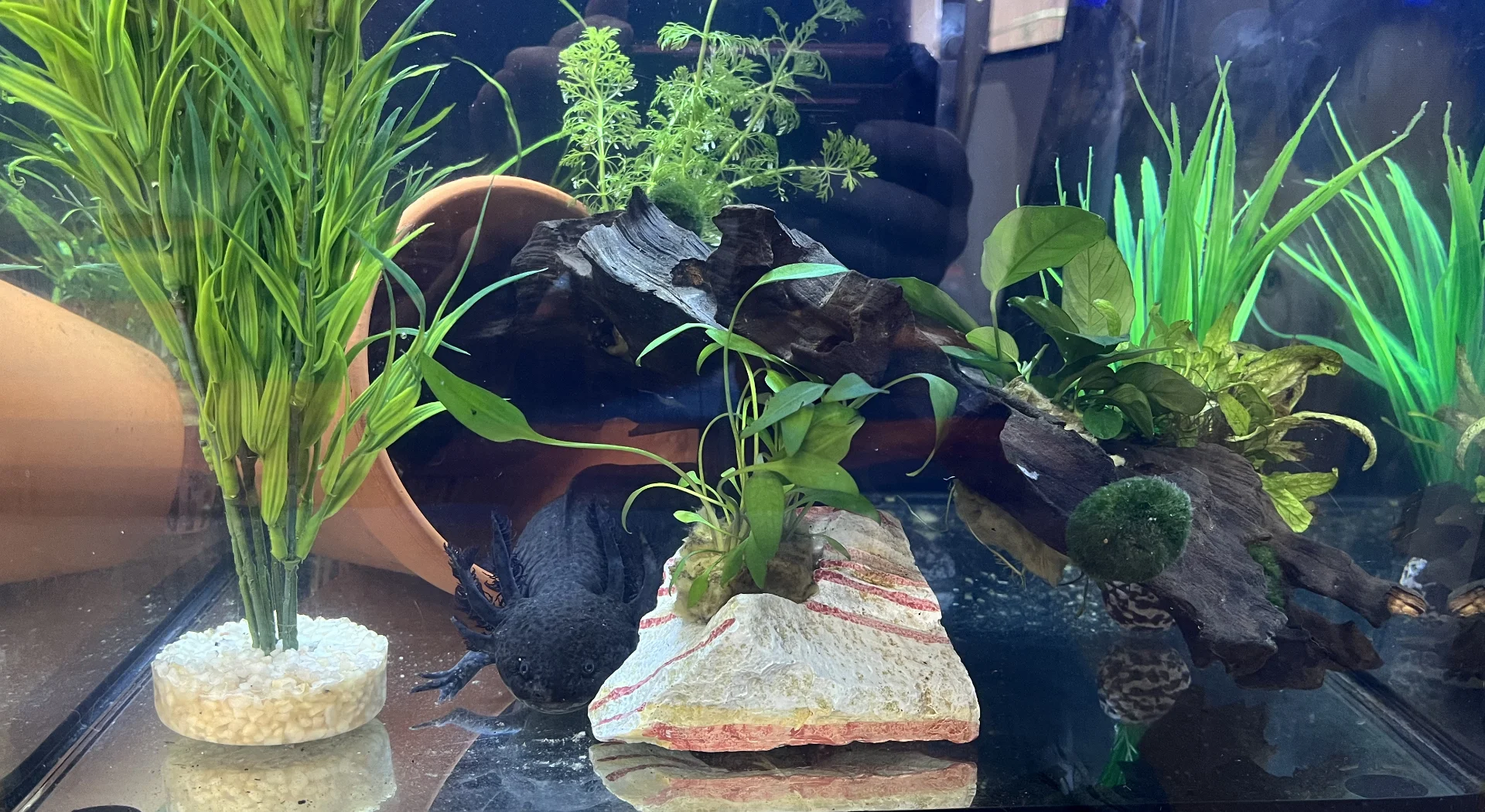
Boop!
| Scientific Name | Ambystoma mexicanum |
| Colourings | Dark Wild morph (Black, with lighter speckles) |
| Date of Birth (Approx.) | June 2023 |
| Gender | Likely to be Male |
| Country of Origin | Mexico View on Google Earth |
| Habitat | Axolotl are found in only one area of Mexico, specifically the freshwater lakes of Xochimilco and Chalco in Mexico City |
| Average Life Span | In the wild Axolotl typically live for about 5 to 10 years, but in captivty, this increases to 10-15 years |
| Alternative Name | Water dog or Water monster (Aztec) |
| Interesting Facts | Axolotls are famous for their neoteny, meaning they retain juvenile features into adulthood. Unlike most salamanders, they don’t undergo complete metamorphosis; they remain aquatic with gills, external fins, and a larval appearance throughout their life. |

Information & Care
Understanding Boop our Axolotl
Boop came to live with us in October 2024, when they were approximately 12 months old. They were an unwanted pet and had sadly outgrown their tank, so we set about providing a luxury set up for Boop to live!
Initially thought to be female, the name given was Betty Boop, but Betty does appear to perhaps be male, so the name has been changed to Boop!
Boop, like all Axolotl prefer cooler waters, are mainly bottom dwellers, and most active at night, with a dislike of light. So whilst lights are necessary for plant growth, and the plants are important for water health, we do balance the light with periods of time where the lights are off. We also provide lots of places to hide.
Boop tends to poop mainly once / twice a week, depending on the frequency and volume of food.
Boop came to live with us in October 2024, when they were approximately 12 months old. They were an unwanted pet and had sadly outgrown their tank, so we set about providing a luxury set up for Boop to live!
Initially thought to be female, the name given was Betty Boop, but Betty does appear to perhaps be male, so the name has been changed to Boop!
Boop, like all Axolotl prefer cooler waters, are mainly bottom dwellers, and most active at night, with a dislike of light. So whilst lights are necessary for plant growth, and the plants are important for water health, we do balance the light with periods of time where the lights are off. We also provide lots of places to hide.
Boop tends to poop mainly once / twice a week, depending on the frequency and volume of food.
Axolotl in their natural environment are apex predators (top of the food chain) and would eat other animals that are smaller than itself (including another Axolotl). For this reason, Boop currently lives alone.
Axolotls are carnivores, feeding mainly on medium dendrobaena worms, with blood worms and / or live river shrimp as an occasional treat.
Boop can be given 2 large or four small dendrobaena worms a day. Additionally, Axolotl pellets are reserved for occasional feeding.
It is important that the dendrobaena worms have fresh substrate, are kept cool and are fed themselves once per week with Willys worms food.
Fish Tank
Boop lives in a 180 litre glass tank measuring 101 x 41 x 50cm with a filtration system, bubblers, decor, hides, thermometer and real plants.
Heat & Lighting
LED lighting is programmed via smart home timers with the following pattern:
Switched on: 08:30 -12:30 and 1:30-3:30
Oxygenation
Flat sand bubbler and Groot bubbler are programmed to be on twice a day, but off at night.
Real plants
Water Temperature
The chiller unit is set to come on when the water temperature exceed 18°C (64°F)
The optimum temperature range is 14-18°C (52-64°F).
Water Quality Parameters
The following are the required water parameters and should be tested with the API water kit:
– Temperature: (see above)
– Ph 7.6
– Nitrite 0ppm
– Nitrate 10-20ppm
– Ammonia: 0ppm
The ammonia alert disk shows when ammonia levels are rising and anything above 0.25 requires intervention (usually water change). If the ammonia alert reads above 0.25 then act quickly and test fully with the API kit. Be prepared to tub Boop (see tubbbing guide) as high ammonia levels are dangerous and can cause burns to the Axolotl
Substrate
Glass bottom only (cleanliness) & natural pebbles.
Boop loves to hide under the bogwood during the day or when the lights are on. Boop also likes to hang out in the bubblers and can be seen taking early morning swims.
The tank needs live plants to aid with water parameters and oxygen levels. Boop also needs fake plants to hide behind, and for healthy bacteria to build up.
– Check the ammonia alarm disk
– Check bubblers are working (scheduled to be on from 9:00am – 6:00pm)
– Check water temperatures are in range
– Spot clean any poops, as necessary
– Feeding as per routine
Daily
Spot clean, when faeces are seen (Boop stays in the tank)
Weekly
– Cleaning and removing algae from surfaces
– Carrying out a 30% water change, sucking out debris from the tanks and then topping up water – this needs to be the same temperature, and the water should be dechlorinated, with prime stability added
– Dead heading and removing decaying plant matter
– Removing and rinsing the in-tank filters (using only tank water)
Quarterly
As per above weekly clean, but checking all ornaments and remove excess algae.
Spot clean, when faeces are seen (Boop stays in the tank)
Weekly
– Cleaning and removing algae from surfaces
– Carrying out a 30% water change, sucking out debris from the tanks and then topping up water – this needs to be the same temperature, and the water should be dechlorinated, with prime stability added
– Dead heading and removing decaying plant matter
– Removing and rinsing the in-tank filters (using only tank water)
Quarterly
As per above weekly clean, but checking all ornaments and remove excess algae.
Did you know?
Axolotls can regenerate (regrow) body parts, such as limbs, heart, spinal cord and even their brains!
Health Check & Emergencies
Like all our animals, Boop should be regularly observed to check condition and health. Amphibians should not be routinely handled as their body is covered in a slime coat that is easily damaged, instead, their overall condition and behaviour is observed daily, alongside the observation and close monitoring of their water quality and environment.
The following form should be completed at least once a week. You will be prompted to complete an animal medical record should any answer cause concern.
The following form should be completed at least once a week. You will be prompted to complete an animal medical record should any answer cause concern.
This is a table showing the Yes/No answers of previous submissions. If the full data submission is required, this must be done from the website backend.
Axolotl
Boop will need an emergency home-based intervention, this could include tubbing if any of the following are observed.
– Toxic water quality (usually a spike in Ammonia or Nitrate
– If there is any evidence of impaction (Boop will likely be floating, tail upwards)
– If Boop has evidence of injuries or fungus, or loss of slime coat that does not look easy to treat in the tank
– if the tank water temperature is not able to be controlled due to chiller failure and temperature exceed 22°C
If Boops’ health does not start to improve after home-based interventions, then make an appointment at Chine House Vets.
– Toxic water quality (usually a spike in Ammonia or Nitrate
– If there is any evidence of impaction (Boop will likely be floating, tail upwards)
– If Boop has evidence of injuries or fungus, or loss of slime coat that does not look easy to treat in the tank
– if the tank water temperature is not able to be controlled due to chiller failure and temperature exceed 22°C
If Boops’ health does not start to improve after home-based interventions, then make an appointment at Chine House Vets.
Supplies & Reference
Here are the regular supplies list for our reptiles. Links are provided to 3rd party websites and are subject to change.
| Item | Where to buy |
|---|---|
| Small Dendrobaen Worms | Willys Worms |
| Worm Substrate | Willys Worms |
| Worm Food | Willys Worms |
| Blood Worms | Monkfield Nutrition |
| API Testing Kit | Amazon |
| Prime Stability | Amazon |
| Prime Dechlorinator | Amazon |
| Dr Timms Ammonia (Only required when setting up a tank) | Amazon |
| First Aid | |
| Methylene Blue | Amazon |
| Bicarbonate of soda (Kept in labelled tub in Axolotl enclosure) | |
| Almond Leaves | Amazon |
| Black Tea | Amazon |
| Item | Reference Link |
|---|---|
| Tubbing Guide | |